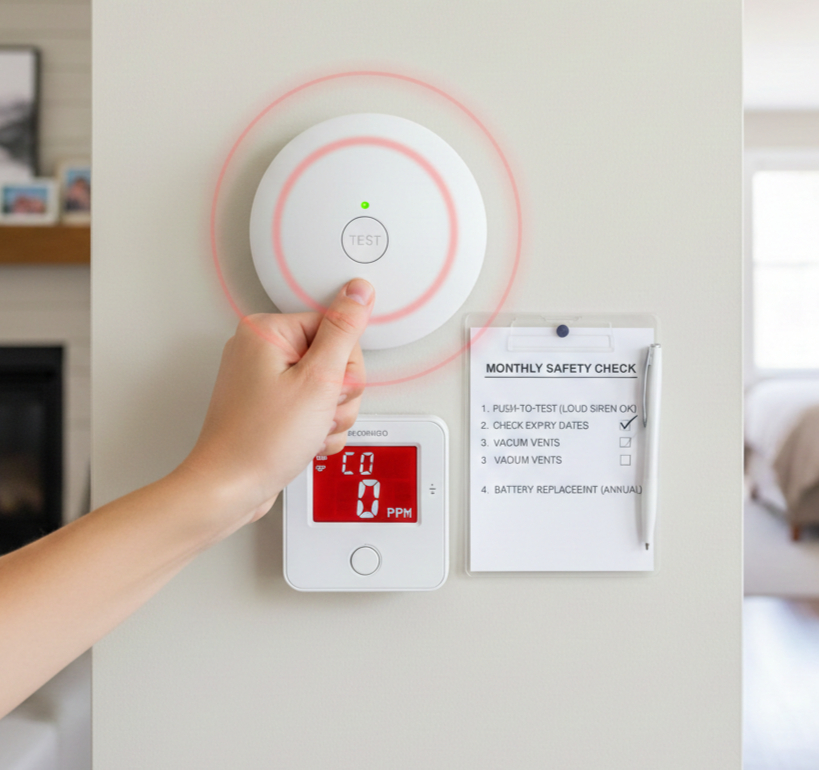
In Oregon, fire and life safety are high priorities, reflected in some of the most comprehensive residential alarm laws in the country. Whether you are a homeowner, a landlord, or a tenant, understanding the specific requirements for smoke and carbon monoxide (CO) detectors is not just a matter of safety—it is a legal obligation.
Oregon’s Legal Requirements
Oregon law (ORS 479.250–479.300) is specific regarding the types of alarms required and where they must be placed.1
Smoke Alarms
In Oregon, all homes being sold or rented must have working smoke alarms.2
- Location: Alarms must be installed on every level of the home (including basements), in every bedroom, and in the hallway outside each sleeping area.3
- Technology: If a battery-operated smoke alarm is an “ionization” type, Oregon law requires it to have a 10-year sealed battery and a “hush” feature to prevent nuisance alarms.4
- Hardwiring: If your home was initially built with hardwired alarms, you must replace them with hardwired units; you cannot “downgrade” to battery-only models.5

Carbon Monoxide (CO) Alarms
CO requirements apply to any home that has a “CO source,” such as a fuel-burning heater, Oregon fireplace, wood stove, or an attached garage.6
- Placement: CO alarms must be located on each level of the home that contains bedrooms, and specifically within 15 feet of each sleeping area.7
- Standards: They must meet UL 2034 or CSA 6.19 safety standards.8 Unlike smoke alarms, CO alarms can be plug-in, battery-operated, or hardwired.9
- +1
Landlord and Tenant Responsibilities
In rental properties, Oregon law divides duties clearly to ensure the system never fails.
|
Installation
|
Must provide working alarms at move-in. | N/A |
|
Initial Testing
|
Must provide written testing instructions. | Must test at move-in. |
|
Maintenance
|
Must repair/replace if notified of a defect. | Must replace batteries as needed. |
|
Routine Testing
|
N/A |
Must test at least every six months.
|
|
Compliance
|
Cannot enter agreement without working alarms. | Prohibited from tampering or removing. |
How to Test Them Monthly
While Oregon law requires tenants to test every six months, fire marshals and safety experts strongly recommend monthly testing. Electronic components can fail, and dust or insects can interfere with sensors.
1. The “Push-to-Test” Method
The most common way to test is using the test button.10
- Alert the Household: Let everyone know a test is coming, so the loud noise doesn’t cause panic.
- Press and Hold: Press the test button. It may take a few seconds, but it should emit a loud, piercing siren.
- Verify Sound: Ideally, have another person stand in the furthest room to ensure the alarm is audible throughout the house.
2. Checking the Date
Flip the device over and check the manufacturer’s date.
- Smoke Alarms: Must be replaced every 10 years.11
- CO Alarms: Typically expire every 5 to 7 years.12 If your CO alarm starts chirping once every minute (a different sound than the low-battery chirp), it likely means the sensor has reached the end of its life.

Professional property management is a call or click away! Contact us today
3. Physical Inspection and Cleaning
A test is only half the battle. If the sensor is blocked, the alarm won’t trigger in a real emergency.
- Vacuum the Grates: Use a vacuum attachment or a can of compressed air to remove dust, cobwebs, and debris from the side vents.13
- Check the Light: Most units have a small LED that flashes periodically to show the unit is receiving power.
4. Battery Replacement
Unless you have a 10-year sealed unit, replace the batteries at least once a year. A popular tip is to “change your batteries when you change your clocks” for Daylight Saving Time.14

Contact Us
Tired of wasting time managing your rental properties yourself? Instead concerning yourself with carbon monoxide or CO2 detectors, why not let our property management team handle the day-to-day responsibilities of property management for you?
Learn more about the services that we can offer you by calling us at (503) 646-9664 – Talk to a Live Person – Our office answers the phone 9 AM to 5 PM Monday through Friday – or click here to connect with us online.